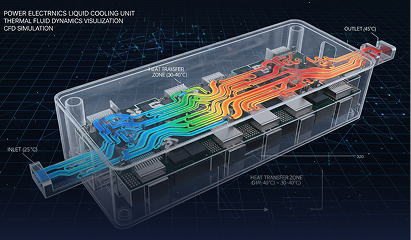
Thermal and structural coupling reduced risk while trimming weight.
Fluid Domain CFD
High-fidelity transient CFD simulation in ANSYS Fluent to model pulsating pressure waves and turbulence structures.

Reduced component weight while maintaining safety margins.
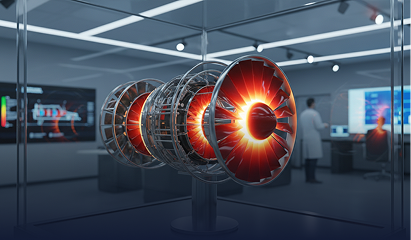
A major chemical processor encountered premature mechanical failures at critical branch welds of their high-pressure fluid manifold. Pulsating flow caused two upstream pumps to induce complex, cyclic fluid-dynamic loads and critical structural stress concentrations.
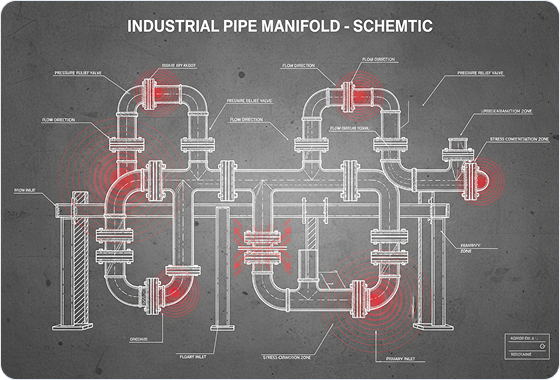
A coupled fluid-structure workflow connected transient pressure loading with structural response and fatigue assessment.
High-fidelity transient CFD simulation in ANSYS Fluent to model pulsating pressure waves and turbulence structures.
Time-varying pressure profiles mapped from the fluid boundary directly onto the structural FEA surface grid.
Static and transient structural models calculate deformation, cyclic strain, and peak von Mises stresses.
S-N curves and weld classifications predict system fatigue life limits at hot-spot weld lines.
This section outlines the core assumptions, meshing strategy, and solver settings used to simulate flow-induced stress. The goal is to provide a clear, readable record of the methodology—making it easier to reproduce results and validate the model.
The mesh was generated using a hexahedral core strategy with localized refinement at weld fillets and interface junctions. This approach balances computational cost with boundary layer resolution, ensuring that the first-layer cell height is controlled to achieve a y+ value of ~1.
Key metrics
Total cell count: 12.4 million elements. The mesh is designed to support transient simulations with minimal numerical diffusion while maintaining a stable CFL condition.
The simulation employs the SST k-omega turbulence model with curvature correction. The PISO pressure-velocity coupling scheme is selected for stable transient formulation, and the time-step size is restricted to 1e-4 seconds to capture higher-order pressure harmonics.
Fixed piping support constraints are applied at anchor points matching physical structural hangers. A cyclic time-series pressure load is mapped dynamically using spatial interpolation to capture localized structural deflection.
High-cycle fatigue evaluation is performed based on the ASME Boiler and Pressure Vessel Code Section VIII Div 2. Multi-axial fatigue is resolved using the Goodman relation and Rainflow cycle counting algorithms.
Results are extracted for key locations and summarized in a fatigue damage report. This includes stress cycles, usage factors, and critical locations identified by the solver.
Thermal and structural coupling reduced risk while trimming weight.
Peak von Mises weld stresses at critical branch connections decreased safely below structural thresholds.
Calculated life cycles under continuous pressure pulsations exceeded the target design requirement.
Accelerometers placed on actual operational piping validated simulated harmonic vibration frequencies.
Partner with Digiwise Innovations for world-class simulation expertise and advanced computational engineering solutions.