What We Evaluate
As part of our finite element analysis (FEA) services, we investigate:
- Natural frequencies and mode shapes: understand how the structure tends to vibrate.
- Vibration response: assess displacement, acceleration and stress under defined excitation.
- Time-dependent behavior: track the response to changing loads, startup events or shock.
- Impact response: evaluate contact forces, deformation and energy transfer during a defined collision or drop event.
Analysis Matched to Your Loading Conditions
Modal Analysis
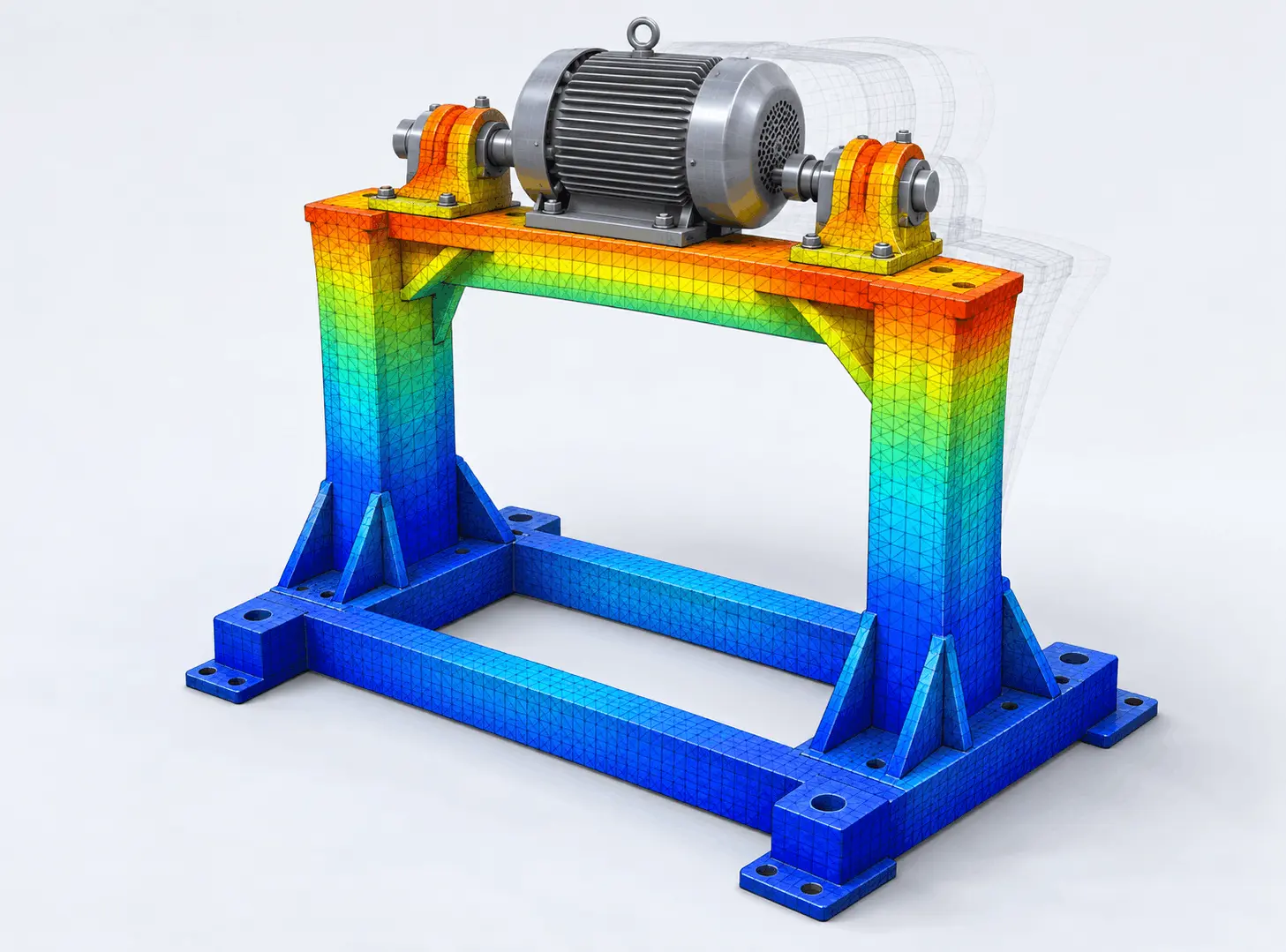
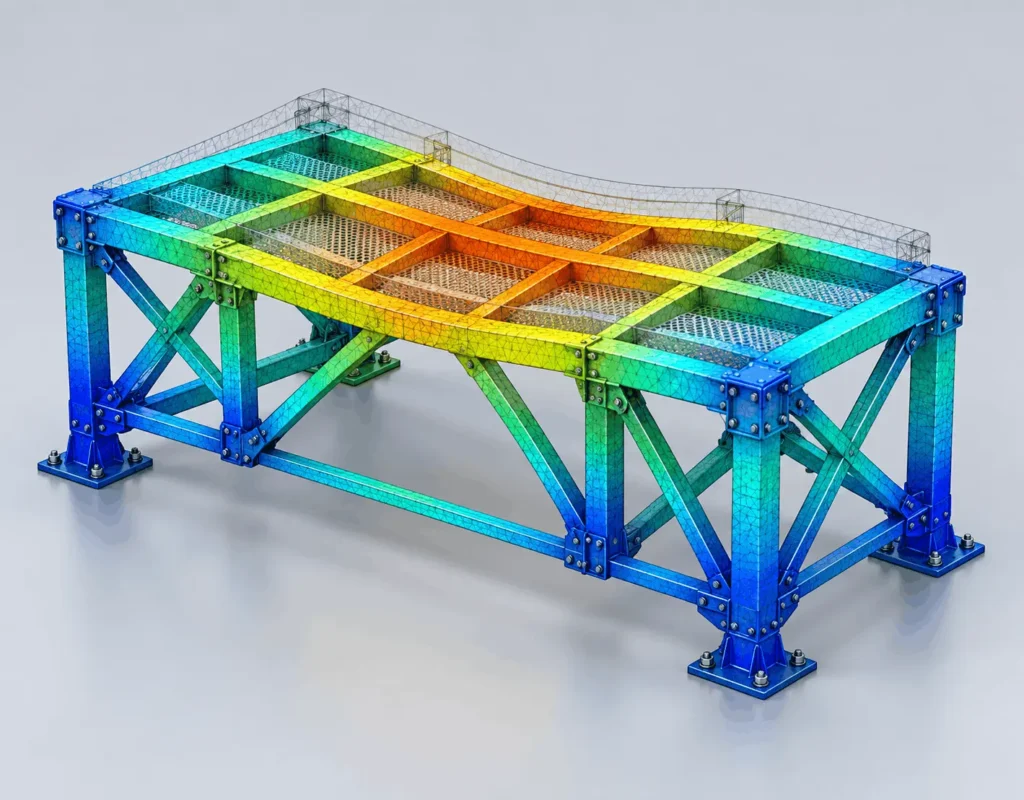
Determine natural frequencies and corresponding mode shapes. Compare them with operating excitation frequencies to identify potential resonance concerns and guide changes to stiffness, mass or supports.
Vibration Analysis
Evaluate the response to periodic excitation using harmonic analysis, or specified broadband excitation using random vibration analysis where appropriate. Assess whether vibration levels could affect structural performance or function.
Transient Dynamic Analysis
Track stress, displacement and acceleration over time under a defined load history. Useful for changing forces, startup and shutdown events, shock pulses and other situations where peak response may occur briefly.
Impact Analysis
Investigate short-duration contact events such as drops or collisions. The assessment may need to capture changing contact, large deformation, plasticity or strain-rate effects, depending on the event and material.
For yielding, large deformation or changing contact, nonlinear FEA may be needed to represent the relevant behavior.
Typical Applications
Machine frames, equipment mounts, rotating-machinery supports, automotive components, electronics assemblies and products exposed to handling shocks or drop events.
Our Analysis Process
- Define the event: establish operating frequencies, excitation data, load histories or impact conditions.
- Prepare the model: define geometry, materials, mass distribution, supports, contacts and damping.
- Run the appropriate analysis: select modal, vibration, transient or impact methods around the engineering question.
- Review critical response: identify governing frequencies, locations and time points, with relevant numerical checks.
- Recommend improvements: compare design changes against agreed performance requirements.
What You Receive
Depending on the agreed scope, deliverables can include:
- Natural frequencies and mode-shape visualizations.
- Frequency-response or time-history results.
- Relevant stress, displacement and acceleration plots.
- Assessment of critical locations and operating conditions.
- Documented assumptions, numerical checks and design recommendations.
Our structural and stress analysis services can complement the dynamic assessment with checks under steady mechanical loads.
What We Need to Get Started
Share your CAD geometry, material data, component masses and mounting details. Include operating speeds, excitation frequencies, force or acceleration histories, damping information, or impact mass and velocity where available. Define acceptable vibration, displacement or stress limits, and provide existing test data if available.