
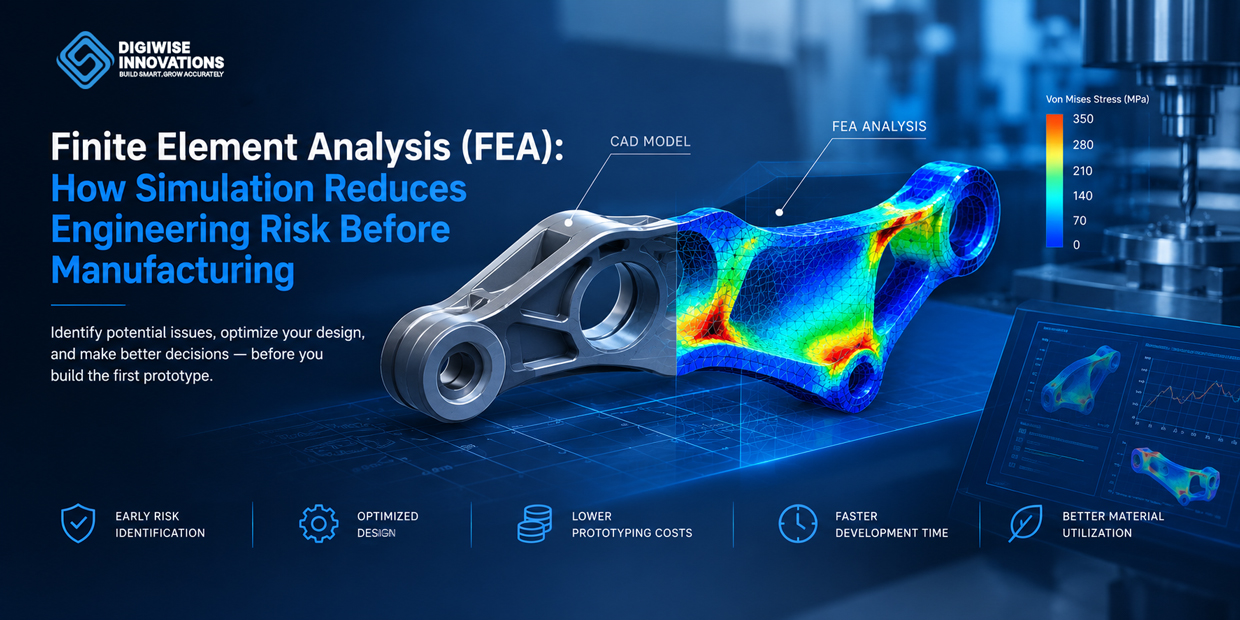
Finite Element Analysis (FEA) allows engineers to evaluate how a product is likely to perform before committing to physical manufacturing. By identifying structural, thermal, and mechanical risks during the design stage, engineering teams can reduce costly redesigns, optimize material use, and make better-informed decisions before building the first prototype. In this article, we explore how FEA helps reduce engineering risk, prototyping costs, and development time throughout the product development process.
Key Takeaways
- Finite Element Analysis (FEA) predicts how a product will respond to mechanical, thermal, and other operating conditions before manufacturing.
- FEA can identify excessive stress, deformation, buckling, contact problems, and other potential failure modes early in product development.
- Virtual prototyping helps reduce the number of costly physical design-build-test iterations.
- Engineers can use simulation to compare design alternatives and optimize material use, weight, stiffness, and structural performance.
- Using FEA early in the design process can reduce engineering risk, development time, and overall product development cost.
What Is Finite Element Analysis (FEA)?
Finite Element Analysis (FEA) is a numerical engineering method used to predict how components and assemblies respond to real-world operating conditions.
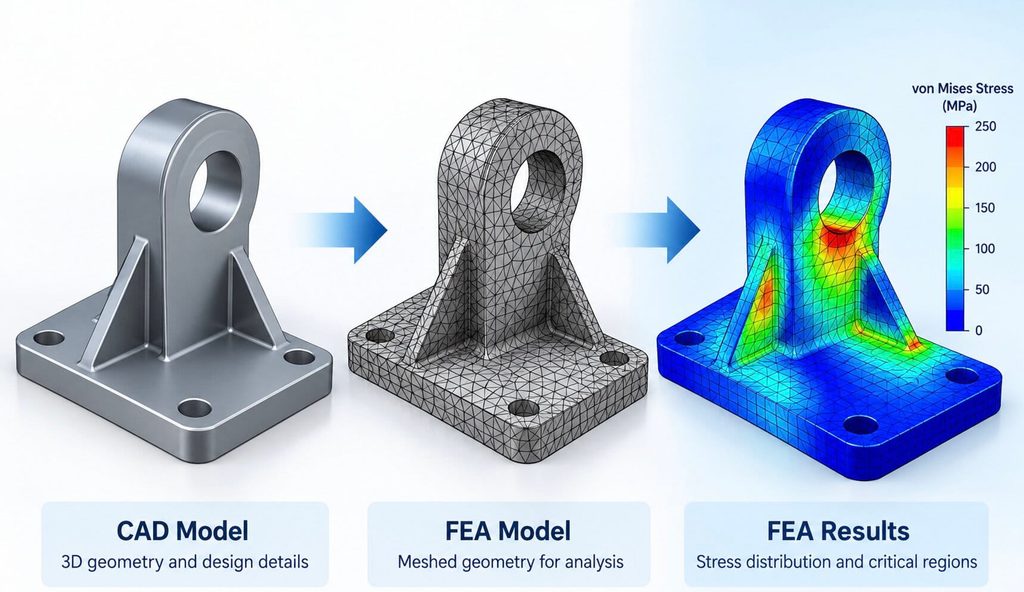
The geometry is divided into many smaller regions called finite elements. Material properties, loads, supports, contacts, temperatures, and other physical conditions are then applied to create a numerical representation of the real product.
Depending on the problem, FEA can predict stress, strain, deformation, temperature, contact pressure, buckling, fatigue, and dynamic response.
This makes FEA much more than a final design check. When introduced early enough, it becomes a powerful virtual prototyping tool for making engineering decisions before committing to manufacturing.
Why Manufacturing Problems Become Expensive
A component can look perfectly acceptable in CAD while still having serious engineering problems.
A thin region may experience excessive stress. A bracket may be strong enough but too flexible. A connection may separate under load. A lightweight structure may buckle. Thermal expansion may create unexpected deformation.
If these problems are discovered only after manufacturing a prototype, engineers may need to modify the design, manufacture another part, repeat testing, and possibly modify tooling or production processes.
The later a design problem is discovered, the more expensive it can become to correct.
FEA shifts part of this learning process to the virtual design stage, where modifications are generally faster and less expensive.
How FEA Reduces Physical Prototyping Costs
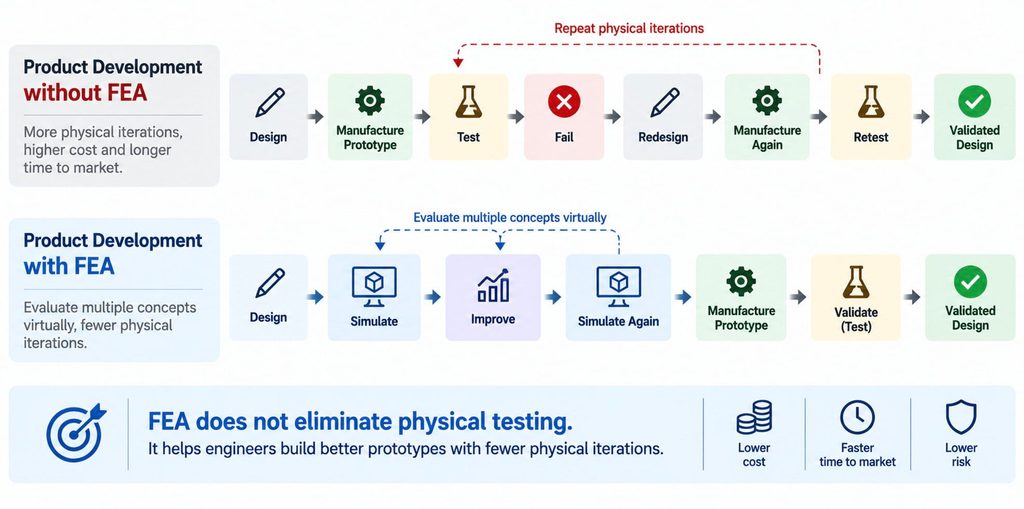
Physical testing remains essential for many engineering products. The purpose of FEA is not necessarily to eliminate prototypes, but to make physical testing more focused and effective.
Without simulation, a development cycle might involve:
Design → Manufacture → Test → Fail → Redesign → Manufacture Again → Retest
With FEA incorporated earlier:
Design → Simulate → Improve → Simulate Again → Manufacture → Validate
Several concepts can therefore be evaluated before producing the first physical prototype.
For startups and R&D teams, this can be particularly valuable when prototypes require expensive materials, CNC machining, molds, specialized manufacturing processes, or long lead times.
How FEA Shortens Product Development Time
Simulation also allows engineers to perform design iterations much faster.
Suppose an engineering team needs to determine whether increasing a fillet radius, changing wall thickness, adding a rib, or selecting another material will improve a component.
Manufacturing and testing every alternative may take considerable time. In an FEA environment, engineers can modify the model and compare several configurations before selecting the most promising design.
This is especially useful during iterative product development, where multiple decisions must be made regarding geometry, material selection, stiffness, strength, connections, and structural reinforcement.
FEA therefore helps shorten the path from an initial CAD concept to a manufacturing-ready design.
Using FEA to Reduce Material and Manufacturing Costs
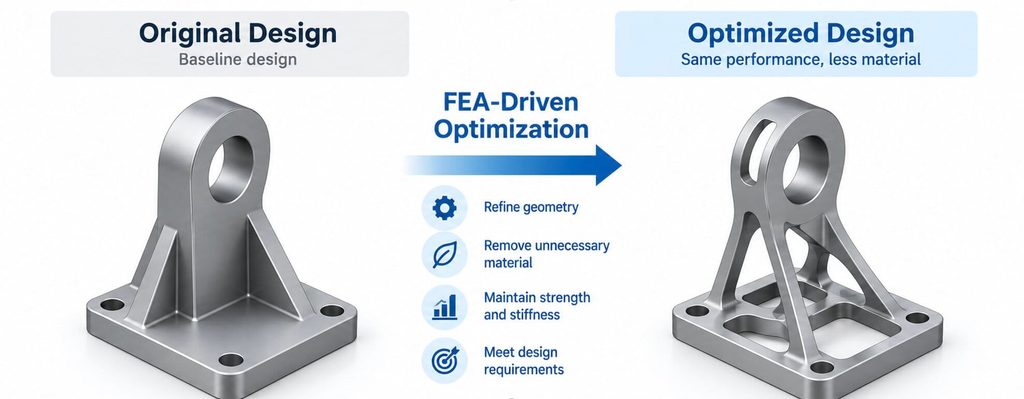
A successful design should not simply be strong enough. It should use material efficiently.
An over-designed component may satisfy its structural requirements but contain unnecessary material, increasing weight and manufacturing cost.
FEA helps engineers visualize how loads travel through a structure. Regions experiencing high stresses can be reinforced, while lightly loaded regions may offer opportunities for material reduction.
Simulation can also support design optimization and topology optimization, helping engineers balance competing requirements such as:
Strength + Stiffness + Weight + Safety + Manufacturability + Cost
This is particularly valuable when production volumes are high, because even a relatively small reduction in material per component can become significant across thousands of manufactured parts.
FEA Goes Beyond Simple Stress Analysis
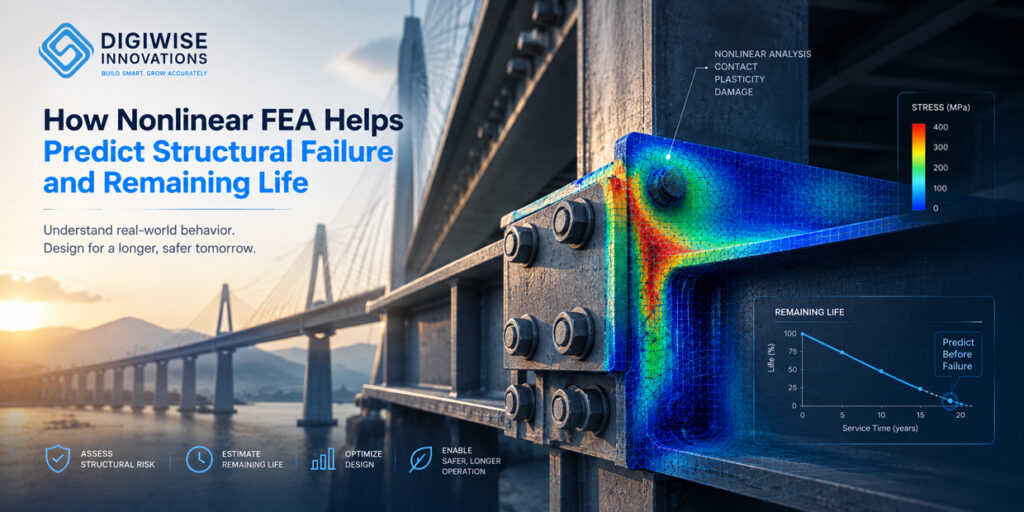
Many real engineering problems cannot be represented accurately using only a simple linear static analysis.
Products may experience plastic deformation, large displacement, complex contact, nonlinear material behavior, thermal loading, buckling, fatigue, vibration, or impact.
Advanced finite element simulation allows these behaviors to be incorporated when they are relevant to the engineering problem.
At DigiWise Innovations, our FEA services cover areas including:
- Structural and nonlinear FEA
- Contact analysis
- Thermal and thermo-mechanical simulation
- Buckling and structural stability
- Fatigue and durability
- Dynamic and impact analysis
- Material failure prediction
- Design and topology optimization
Engineering tools such as Abaqus and ANSYS can then be combined with appropriate material models, boundary conditions, and engineering judgement to reproduce the expected operating environment.
The objective is not simply to produce a colorful stress contour. A useful simulation should answer a design question and support an engineering decision.
When Should FEA Be Used in Product Development?
FEA provides the greatest value when it is integrated before the design becomes expensive to change.
Engineers can use simulation during product development to answer questions such as:
- Where is the design likely to fail first?
- Is the component too flexible?
- Is the safety margin sufficient?
- Can weight or material usage be reduced?
- Could the structure buckle?
- How will temperature affect dimensional stability?
- Which design alternative performs better?
- What happens under extreme operating conditions?
Answering these questions before manufacturing gives engineers more confidence when deciding whether a design is ready for physical prototyping and production.
Frequently Asked Questions About Finite Element Analysis
Can FEA Completely Replace Physical Testing?
No. FEA and physical testing are complementary engineering tools. Simulation can reduce unnecessary prototypes and help engineers focus testing on the most important load cases, while physical validation remains important for confirming real-world product behavior.
Is FEA Useful Only for Large Companies?
No. FEA can be particularly valuable for startups and small R&D teams because manufacturing multiple prototypes may consume a significant portion of a development budget. Virtual design iterations allow more concepts to be evaluated before spending money on manufacturing.
Can FEA Be Performed Directly From a CAD Model?
A CAD model is normally the starting point, but a reliable FEA model also requires appropriate material properties, contacts, loads, boundary conditions, meshing, and analysis settings. The quality of these engineering assumptions strongly influences the usefulness of the results.
What Software Is Commonly Used for FEA?
Commercial engineering platforms such as Abaqus and ANSYS are widely used for finite element simulation. The appropriate software and analysis method depend on the physics, material behavior, loading conditions, and complexity of the engineering problem.
Simulate Before You Manufacture
Finite Element Analysis gives engineers an opportunity to understand how a design may behave before committing time and money to manufacturing.
Used effectively, FEA can help reduce physical prototype iterations, identify potential failures earlier, optimize material usage, shorten development cycles, and reduce overall engineering and manufacturing risk.
For startups, R&D teams, and product development companies, the key question is therefore not simply whether a CAD model can be manufactured, but whether it will perform as intended once it is manufactured.
At DigiWise Innovations, we use advanced engineering simulation to help transform CAD models into informed engineering decisions—identifying potential problems while they are still virtual and considerably easier to change.
Before you build it, simulate it.